The science
Every milligram, explained
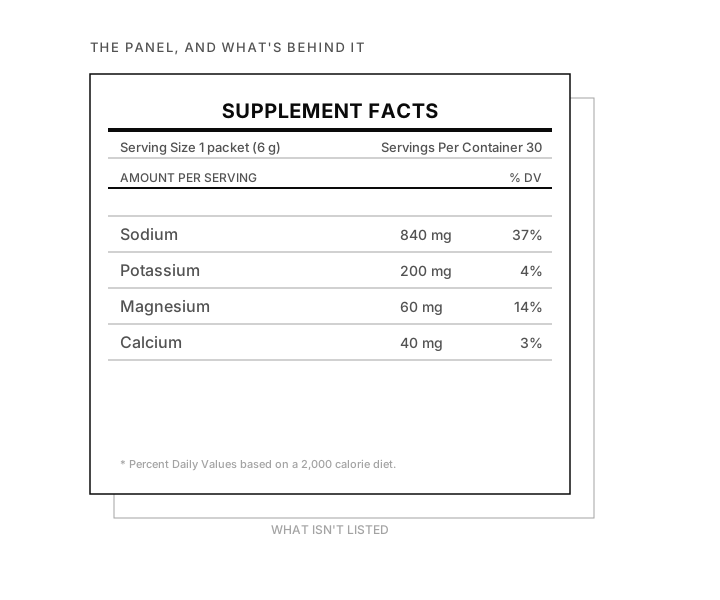
Four mineral salts, one absorption mechanism, and the arithmetic behind every dose. This page is the back panel of the package, expanded. The numbers are the product.
01 · Salt chemistry
Citrate, not chloride
Sodium chloride is the default way to put sodium in water. It is table salt. It works, it costs almost nothing, and at an effective dose it makes a drink taste like seawater and sit hard on an empty stomach.
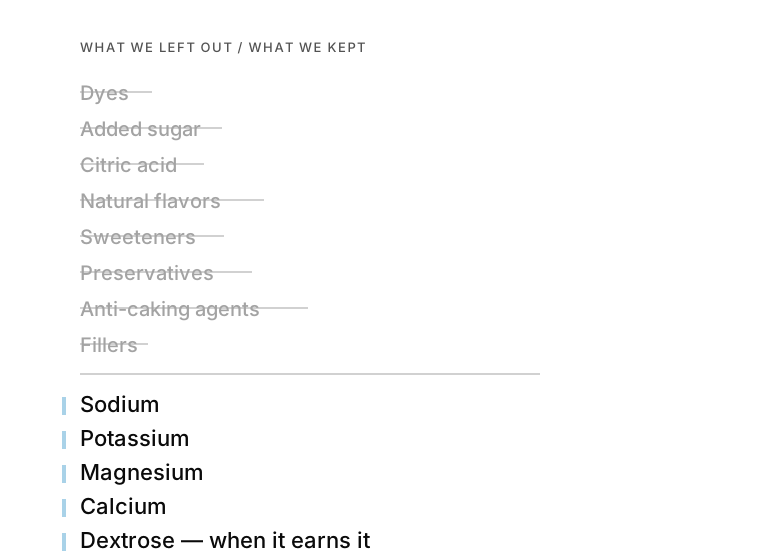
We use sodium citrate instead — the same sodium, attached to the citrate ion, the salt form of the molecule at the center of your cells’ own energy cycle. Formulated with sodium citrate instead of sodium chloride — gentler on the stomach. Citrate-based electrolytes are easier on the digestive system than chloride-based formulas. That sentence is a formulation fact, not a medical one, and it is the reason this brand exists.
Why it doesn’t taste salty
Saltiness is a pairing. The sodium ion drives the signal, and a small anion like chloride lets that signal land at full strength — which is why sodium chloride is the reference point for “salty.” Taste research has measured the other side of this for decades: the larger the anion, the weaker the salty percept. Citrate is a large anion. Tie 2,000 mg of sodium to it and the seawater note never arrives.
No sodium chloride. Less bite. More comfortable to drink on an empty stomach.
Two piles, same sodium
Citrate is the heavier carrier. Sodium chloride is 39 percent sodium by weight; trisodium citrate dihydrate is 23.45 percent. Delivering the same 2,000 mg of sodium takes somewhat more powder. That is the cost of a drink you can sip at 7 a.m. before anything else has happened to your stomach, and we pay it on every serving.
| Carrier | Sodium by weight | Powder for 2,000 mg sodium | In solution |
|---|---|---|---|
| Sodium chloride (table salt) | 39% | 5.1 g | Sharp, unmistakably salty |
| Sodium citrate, dihydrate | 23.45% | 8.53 g | Mild, near-neutral, faintly mineral |
02 · pH
Mildly alkaline, on purpose
Dissolve a scoop and the solution settles slightly on the alkaline side of neutral. That is not an accident, and it is not a health claim. It is what citrate salts do in water.
Citrate buffers. Citric acid bites.
Most flavored electrolyte mixes get their tartness from citric acid, and the acid does two jobs at once: it makes the drink taste sharp, and it pulls the pH well into the acidic range. Citrate salts are the conjugate base of that same acid — the family resemblance with the opposite slope. In water they buffer gently above neutral instead of dropping below it. Slightly alkaline pH — free from the tartness of citric-acid mixes.
No citric acid. No sour edge. A cleaner, smoother taste.
What that means for your teeth
Dental chemistry has one number worth knowing: enamel begins to demineralize when its surroundings drop below roughly pH 5.5. Citric-acid drinks sit well under that line, and a drink designed to be sipped for hours keeps enamel under that line for hours. A citrate-buffered mix sits on the other side of it. No citric acid means no enamel-erosion risk from acidity. Unlike citric-acid electrolyte drinks, Just Electrolyte is non-acidic.
Tooth-enamel-friendly formulation — no citric acid, no carbonic acid.
What we are not claiming
Your blood pH is held inside a narrow band by your lungs and kidneys, regardless of what you drink. A mildly alkaline beverage does not alkalize your body, raise your blood pH, or balance anything internal — the body regulates its own pH, full stop. The pH of this formula is a statement about taste, about formulation, and about what your teeth are bathed in while you drink it. Nothing more.
03 · Absorption
The SGLT1 mechanism
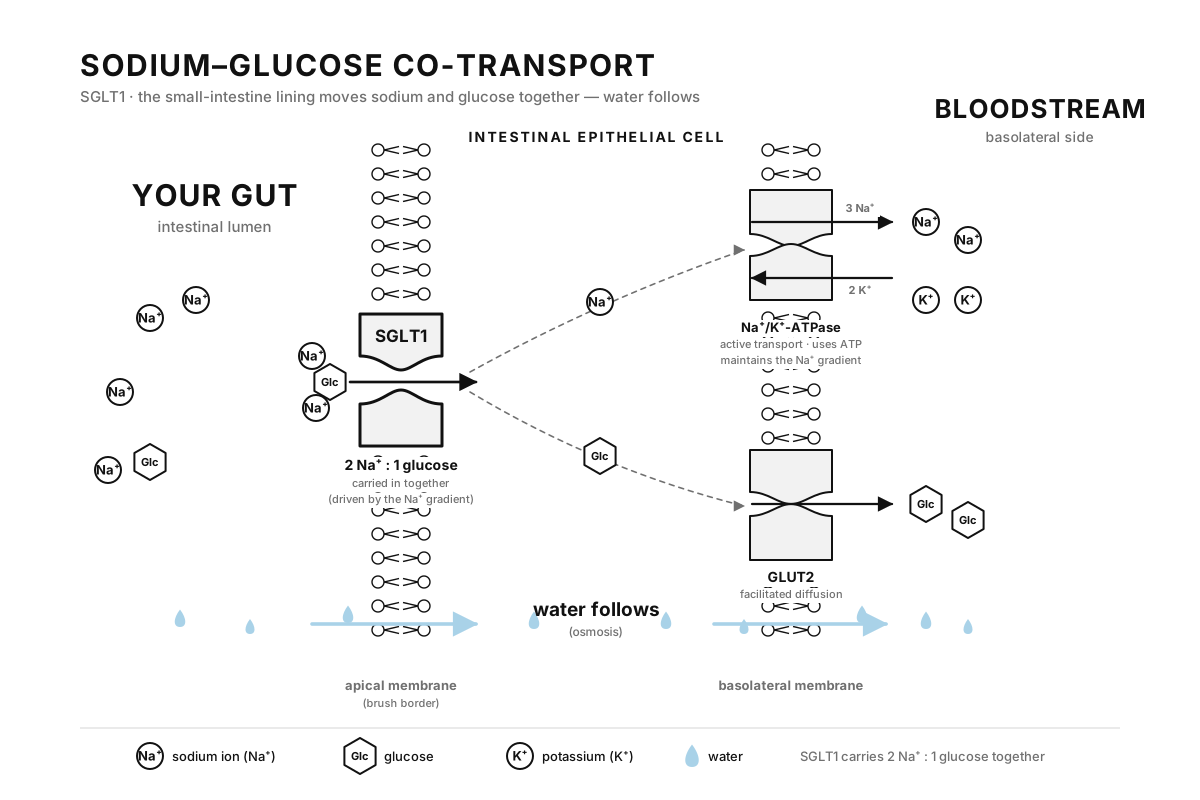
Quick Rehydrate carries about 2.4 grams of dextrose per bottle — the minimum effective dose to open the SGLT1 sodium-glucose pathway, not a gram more. Here is exactly why.
The lining of the small intestine carries a transport protein called SGLT1 — sodium-glucose cotransporter 1. It moves sodium and glucose across the gut wall together, in fixed ratio. The glucose is the key that turns the lock for sodium, and water follows the sodium osmotically. The same sodium-glucose co-transport mechanism behind WHO oral rehydration therapy. The mechanism is not novel and it is not ours; it is some of the most thoroughly established transport physiology there is. We just dose to it.
The minimum effective dose
SGLT1 saturates. Past the amount of glucose needed to run the transporter, additional sugar stops assisting absorption and starts being just sugar. So Quick Rehydrate carries four grams of dextrose per liter — about 2.4 grams in a 20-ounce bottle. Enough to engage the mechanism. Not enough to taste sweet. Not fuel for anything. A precise amount of dextrose activates SGLT1 co-transport — helping your intestines absorb sodium and fluid faster. Contains ~2.4 g dextrose per bottle — functional, not sweet.
Why the all-day formula has none
A gallon sipped across a day does not need accelerated uptake; ordinary absorption keeps pace with a glass at a time. So the Normal formula carries no dextrose at all — sugar-free, because the mechanism only earns its place when the clock matters. The dextrose appears exactly where the science calls for it, and nowhere else.
Quick Rehydrate — per 20 fl oz sachet Na 469 mg K 117 mg Mg 14 mg Ca 12 mg Dextrose ~2.4 g
This statement has not been evaluated by the Food and Drug Administration. This product is not intended to diagnose, treat, cure, or prevent any disease.
04 · Mineral forms
Four salts, each for a reason
Every mineral in this formula could be delivered by a cheaper salt. Each form below was chosen for how it behaves in a glass of water — solubility, taste, pH — and each choice costs more than the default. The label lists them. This is the reasoning.
Sodium
Sodium citrate
Trisodium citrate dihydrate, 23.45% elemental sodium. The spine of both formulas: carries sodium without chloride’s salt bite, buffers the solution mildly alkaline, dissolves clear, gentler on the stomach. Section 01 is its argument in full.
Potassium
Potassium citrate
Tripotassium citrate monohydrate, 36.16% elemental potassium — the densest clean carrier available. Same citrate logic, same clear solution. Potassium chloride reads bitter and metallic in water at meaningful doses; the citrate stays quiet.
Magnesium
Magnesium citrate
Anhydrous trimagnesium citrate, 16% elemental magnesium. Magnesium oxide is the cheap default, and it mostly refuses to dissolve in a glass of water. Trimagnesium citrate goes into solution fully and stays there. If it isn’t dissolved, it isn’t in the drink.
Calcium
Calcium lactate
Calcium lactate pentahydrate, 13% elemental calcium. Calcium carbonate is chalk — it sinks, it leaves sediment, and it needs an acid we refuse to add. Calcium lactate is highly water-soluble and taste-neutral at our dose. It dissolves clear and stays neutral.
The ratio is the formula
The all-day blend runs sodium to potassium at 2:1 — 2,000 mg against 1,000 mg across a gallon. A normal day loses sodium steadily, and most diets already run short of potassium, so the all-day formula replaces both, in proportion, for as long as you are drinking it.
Quick Rehydrate runs 4:1 — 3,000 mg of sodium per gallon (793 mg per liter) against 750 mg potassium per gallon — because acute rehydration is a sodium problem first. Sodium is what SGLT1 moves, and sodium is what the water follows. Potassium rides along at maintenance. Two jobs, two ratios, no compromise blend pretending to do both.
| Mineral | Form | Normal — 1 scoop → 1 gal | %DV | Quick Rehydrate — 4 scoops → 1 gal | %DV |
|---|---|---|---|---|---|
| Sodium | Sodium citrate, dihydrate | 2,000 mg | 87% | 3,000 mg | 130% |
| Potassium | Potassium citrate, monohydrate | 1,000 mg | 21% | 750 mg | 16% |
| Magnesium | Trimagnesium citrate, anhydrous | 90 mg | 21% | 90 mg | 21% |
| Calcium | Calcium lactate, pentahydrate | 180 mg | 14% | 75 mg | 6% |
| Dextrose | Dextrose monohydrate | 0 g | — | 15 g | 7% |
%DV per FDA adult daily values: sodium 2,300 mg, potassium 4,700 mg, magnesium 420 mg, calcium 1,300 mg, total carbohydrate 275 g. The Normal serving is one gallon, consumed across a day — not in a sitting. Na:K ratio — Normal 2:1, Quick Rehydrate 4:1.
05 · Arithmetic
The dose math
One scoop. One gallon. One day.
The all-day serving is 13.24 grams of blend in one gallon of water — 3.785 liters, mixed once in the morning, finished by evening. Use 1 scoop per liter or 4 scoops per gallon. A gallon is sixteen 8-ounce glasses. Divide across them and each glass carries about 125 mg of sodium, 63 mg of potassium, 6 mg of magnesium, and 11 mg of calcium. That is the whole idea: roughly 529 mg of sodium per liter — a low, steady concentration built for drinking all day without thinking about it. Supports all-day hydration.
The pouch is the gallon, divided
A 20-ounce bottle is 15.6 percent of a gallon, so the Normal pouch holds exactly that fraction of a gallon-serving: 2.07 grams. The bottle in your bag is the same drink as the jug on your counter, at the same concentration, to the milligram. Nothing is re-balanced for the small format. The math is the format.
Quick Rehydrate is a different equation
One 8.22-gram scoop per liter (4 scoops per gallon, 30 gallon-servings per tub). Na:K at 4:1, about 4 grams of dextrose per liter to run the SGLT1 transporter. After the long run, the long flight, the afternoon that got away from you. Quick Rehydrate. For the days that ask more.
| Format | Blend | Water | Na | K | Mg | Ca | Dextrose |
|---|---|---|---|---|---|---|---|
| Normal — tub, 4 scoops | 13.24 g | 1 gal / 3.785 L | 2,000 mg | 1,000 mg | 90 mg | 180 mg | 0 g |
| Normal — pouch, 1 sachet | 2.07 g | 20 fl oz / 591 mL | 312 mg | 156 mg | 14 mg | 28 mg | 0 g |
| Quick Rehydrate — 4 scoops / 1 gallon serving | 31.13 g | 1 gal / 3.785 L | 3,000 mg | 750 mg | 90 mg | 75 mg | 15 g |
Normal — per gallon Na 2,000 mg K 1,000 mg Mg 90 mg Ca 180 mg 2:1 Na:K
06 · Magnesium
Why magnesium rides with the sodium
Sodium gets the water in. Magnesium is the mineral most easily left out of a hydration mix — and the one most people are already short on.
Two different jobs
Sodium governs fluid balance: it is the electrolyte you lose most in sweat, and the one water follows across the gut wall (Section 03). Replace the sodium and you have addressed hydration’s plumbing. Magnesium does something else — it is a cofactor in hundreds of enzymatic reactions and supports normal muscle and nerve function and normal energy metabolism. A mix that is all sodium answers only half the question.
The one that gets skimped
Magnesium is among the most commonly under-consumed minerals in modern diets, and it is the easy one to cut from a formula: it is more expensive than the others, and the cheap form — magnesium oxide — barely dissolves in a glass of water. So a hydration mix can carry a token few milligrams, or a form that settles at the bottom. We use trimagnesium citrate, fully soluble, at 90 mg per serving — alongside the sodium, in both formulas.
What we are not claiming
Magnesium supports normal muscle and nerve function and normal energy metabolism. That is physiology, not a promise about how you will feel. We are not claiming it prevents cramps, fixes fatigue, or treats anything. It is in the formula because a complete electrolyte includes it — in a dose, and a form, that actually make it into the drink.
This statement has not been evaluated by the Food and Drug Administration. This product is not intended to diagnose, treat, cure, or prevent any disease.
07 · Sourcing
What can’t get in
Mineral salts come out of the ground, and they can carry trace heavy metals with them. This is the part of an electrolyte nobody puts on the front of the box.
Where they come from
Lead, cadmium, arsenic, and mercury occur naturally in the mineral deposits that electrolyte salts are refined from. They are not added — they are inherited, in trace amounts that vary by source and by supplier. Virtually every food carries some. The only questions that matter are how much, and whether anyone checked.
Our standard
We source to low-heavy-metal specifications, and test every production batch by ICP-MS — inductively coupled plasma mass spectrometry, the method regulators use — before it ships. We hold each batch below the strictest published limits, including California’s Proposition 65 safe-harbor levels, and keep the certificate of analysis on file.
What we are not claiming
No food is free of trace metals, and we will not pretend ours is. “Clean” here means a low, tested, documented level — not zero. The point of testing every batch is that you do not have to take the word on faith. The number exists.
Read the label, then decide
The shop lists every number on this page again, per format. The FAQ answers what this page raises.